


AI-powered search is bringing significant transformation in consumer behaviour by changing how they discover and purchase products in eCommerce. Earlier, consumers visiting an eCommerce page only saw the same homepage as well as category filters for exploring their desired products. This model is now fading away with widespread expansion of AI-powered eCommerce personalisation that is replacing traditional static storefronts with personalisation and real-time analysis of shoppers’ needs. What once seemed like a futuristic concept has now become a prominent tool for driving measurable business impact. With rising AI adoption and personalised product discovery, online shoppers are now trusting AI-powered product recommendations as compared to traditional digital ads.
For technology teams as well as business leaders, the shift to AI eCommerce personalisation is not merely a marketing tactic, but a competitive necessity that effectively integrates search infrastructure, customer data strategy and recommendation search engines, which gives an AI-driven customer experience.
The Transformation from Static Search to Predictive Discovery: Evolution of Digital Retail
Traditionally, searching for a product consisted of typing a keyword, and the website matched it with a relevant product catalogue to meet consumer needs. This approach faces difficulties as soon as the product catalogue increases and consumers’ intent becomes highly specific.
AI in eCommerce has evolved this equation as it employs advanced natural language processing and uses behavioural signals to analyse specific preferences of shoppers in detail and not merely what they have searched on the website. This has made eCommerce personalisation and AI-powered search a core infrastructural component for gaining a competitive advantage.
With changing times and rising technology development, consumer expectations have also changed just as quickly. According to research done by McKinsey, around 71% of consumers expect eCommerce companies to provide personalised recommendations and interactions, and approximately 76% were reportedly frustrated when brands failed to give a personalised eCommerce experience. This gap is being successfully bridged by AI-driven customer experience and eCommerce personalisation.
How AI-Powered E-Commerce Transforms Product Discovery through Personalised Search
The traditional search bars in online retail have served as major pain points for a long time, as they only relied on keyword matching, which often led to irrelevant results and directed shoppers to ‘no items found’ pages, which increased their frustration.
With natural language processing and vector embeddings, AI-powered search now better matches consumer intent and context by understanding consumer needs and delivering a personalised eCommerce experience.
AI-Powered Search
AI-powered search implements semantic understanding of consumer needs and search intent instead of depending on keyword matching. For example, a consumer searching for ‘lightweight shoes for daily walking and exercise’ gets the most accurate results even if the actual phrase is not present in the product description. This is so because the AI systems interpret and analyse the exact consumer intent rather than only relying on string-matching text. Prominent international eCommerce platforms like Ubuy.com use advanced AI-powered search through its AI assistant called SearchMate. SearchMate helps assist shoppers in a personalised way and interacts with consumers to suggest product recommendations and resolve their queries.
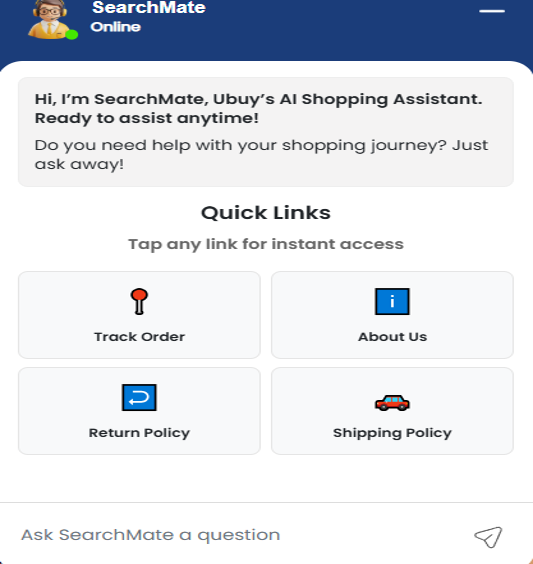
Source: Ubuy.com
Key Benefits of Modern AI-Powered Search Consist of:
- Real-time contextual ranking: Advanced AI-powered search adjusts the search rankings as per shoppers’ price sensitivity, previous purchase history and brand affinities.
- Semantic understanding: Competently interprets typos, consumer slang, and even conceptual search phrases without breaking the actual meaning.
- Visual search: AI-powered search allows consumers to upload images or snapshots for exact product matching or finding similar products.
AI Product Recommendations
AI-powered product recommendations operate side by side with search interfaces to showcase products that consumers are not actually searching for, but they align with their needs, browsing history and previous purchases. These recommendation systems in eCommerce mainly focus on:
- Past purchases of consumers and return history
- Browsing behaviour of consumers within the session
- Identifying patterns from similar shoppers
- Product characteristics and catalogue metadata
Collectively, AI-powered search and AI product recommendations form a personalised product search experience that adapts to varied consumer needs instead of showing an identical storefront to every visitor.
Personalised Product Experience throughout the Consumer Journey
AI-powered recommendations in the eCommerce consumer journey are an effective application of modern artificial intelligence technology. Modern deep learning models often go beyond basic static logic, suggesting products to consumers based on their preferences and evaluating behavioural attributes.
The advanced algorithms used currently synthesise diverse real-time inputs such as active sessions, category exploration, cart items and seasonal purchasing trends. This holistic contextual processing helps in providing hyper-personalised and accurate AI product recommendations at every digital touchpoint:
- Homepage creation: Modern AI uses customised product carousels to target consumers instead of generic hero images.
- Product details page: AI-powered search showcases real-time similar cross-sell options that align with shoppers’ utility needs, style and overall preferences.
- Cart & checkout suggestions: AI helps in providing impulse upsell recommendations and add-ons that gather consumer attention at the checkout.
The eCommerce brands that are implementing AI eCommerce personalisation in their store architecture notice better conversion rates, which instantly increases average order value.
Behavioural Shifts Driven by AI-Powered Recommendations and E-Commerce Personalisation
The increasing growth of AI technology has led to profound changes in consumer behaviour. Consumers now prefer personalisation, frictionless journeys and speed—needs that static search and traditional ads were unable to meet competently.
The most prominent and noticeable change is high consumer trust in AI-powered recommendations in comparison with traditional advertisements. This trust instantly contributes to high conversion rates and rising order values as personalised recommendations appeal to consumers more deeply and accurately.
These behavioural shifts among consumers further manifest in different ways:
- From search to interactions: Consumers are now shifting to conversational interactions from keyword-based and static searches. AI-based chatbots as well as shopping assistants are communicating with consumers to give them personalised recommendations and resolve queries. For example, com, a global eCommerce platform, uses SearchMate for conversational interactions and sharing personalised recommendations with consumers.
- High demand for personalisation: Consumers expect eCommerce brands to anticipate their needs and align with their preferences.
- Omnichannel experience: Consumers prefer personalised interactions throughout their shopping journeys and across different touchpoints. AI-powered recommendations offer a seamless experience and a unified shopping journey.
Developing an AI-Driven Consumer Experience without Overwhelming the Shoppers
Personalisation has several benefits, including improving conversion rates, average order values, and consumer trust. But effective personalisation should always be balanced, as pushing it too far might be perceived as overly intrusive and specific by consumers, which can lower trust. Here are a few practical tips to help strike a balance in a personalisation approach.
- Giving complete visibility as well as control to consumers over their data and how it is being used for shaping recommendations. Transparency is essential for maintaining consumer trust.
- Using only first-party data instead of depending on third-party data tracking.
- Adhering to relevance by giving well-targeted recommendations instead of generic ones.
- Regularly testing personalisation features and analysing engagement impact.
Retailers must treat privacy and transparency as essentials when offering a personalised eCommerce experience, as it helps ensure consumers keep coming back.
Final thoughts
The transformation from search to purchase has now become an adaptive journey that is formed by intent, data and context at every stage of AI-powered eCommerce personalisation. AI-driven recommendations are what make this adaptive journey possible by creating a personalised storefront experience developed for one visitor at a time. Businesses that are competently implementing AI infrastructure with balanced personalisation and consumer privacy are on the path to driving high conversions and transforming discovery into long-lasting loyalty.

