


Businesses are moving artificial intelligence from isolated experiments into everyday operations. Employees use AI to summarise documents, analyse information, draft communications, support customer service and assist software development. Yet wider adoption does not automatically produce lower operating costs, higher revenue or better business decisions.
The difficult question for executives is no longer whether their teams can use AI. It is whether the technology improves the outcomes that matter to the organisation.
Answering that question requires more than tracking usage or counting completed projects. Companies need to identify specific business problems, establish performance baselines, measure results after deployment and account for the additional costs and risks created by AI. Without that discipline, adoption can rise while financial returns remain difficult to demonstrate.
Adoption Is Not the Same as Business Impact
AI adoption continues to expand, but reported financial results remain uneven. McKinsey’s 2026 survey of 1,719 respondents across 97 countries found that nearly nine in ten reported regular AI use in at least one business function. However, only 37% reported that AI had contributed positively to their organisations’ earnings before interest and taxes (EBIT), while 80% said AI had improved their individual productivity.
The gap matters. An employee may finish a task faster without reducing departmental costs if colleagues spend additional time verifying the output, correcting errors or integrating it into existing systems. Productivity gains at the task level do not automatically translate into financial benefits across the business.
Consider an AI tool that reduces the time required to prepare a customer report from two hours to 30 minutes. Preparation time has fallen by 75%, but the business benefit depends on what happens next. Does the employee handle more customer work? Does the organisation reduce overtime? Does the report reach the customer sooner? Does its accuracy improve?
If none of those outcomes changes, the tool may have improved one task without creating a measurable financial return.
Executives should distinguish three levels of progress:
- Usage: Employees use the technology regularly.
- Operational improvement: A process becomes faster, more accurate or less resource-intensive.
- Business value: The improvement contributes to measurable cost savings, additional revenue, better service or reduced risk.
Each level provides useful information, but the final assessment must connect the technology to a business result.
Choose the Business Problem Before the AI Tool
A common mistake is to begin with a technology and then search for a problem it might solve. A more disciplined approach starts with an existing operational difficulty.
A finance team might need to reduce invoice-processing time or investigate payment discrepancies. A manufacturer might want to identify defects earlier in production. A customer service department might need to reduce repeat contacts or help agents resolve complex requests.
Each objective calls for different measures.
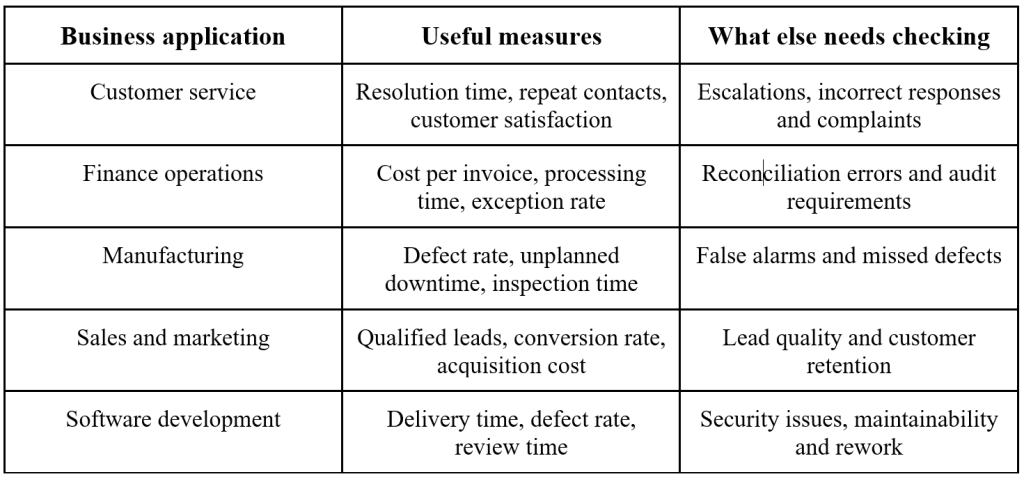
The measures should reflect the actual objective, rather than whichever statistic is easiest to collect. A chatbot that answers more questions may still perform poorly if it generates repeat contacts. An automated processing system may handle more transactions while introducing errors that require expensive manual correction.
Establish a baseline before implementation. Otherwise, it becomes difficult to distinguish the effect of AI from seasonal demand, staffing changes or other process improvements.
Calculate the Full Cost of AI
The purchase price or subscription fee is only one part of the cost of deploying AI. Organisations must also consider system integration, data preparation, staff training, human review, security controls, maintenance and ongoing computing expenses.
Costs can change considerably when usage expands. A pilot involving a small group of employees may appear inexpensive, while wider deployment increases processing requirements, support needs and the volume of outputs requiring review. McKinsey’s 2026 survey found that approximately one in five respondents said AI-related operating costs had constrained their organisation’s use of the technology.
Commercial investment is also growing. Markntel Advisors’ AI market analysis estimates the global artificial intelligence market at USD 712 billion in 2025 and projects it to reach USD 802 billion in 2026 and USD 1.729 trillion by 2032. These figures illustrate the scale of investment in AI technologies, but they do not indicate the return an individual organisation should expect.
Business leaders should assess net value rather than treating time saved as equivalent to money saved.
Net benefit = verified financial gains + cost savings − total implementation and operating costs
Financial gains might include additional sales attributable to the system. Cost savings could come from reduced manual processing, fewer errors or lower external service expenditure. The analysis should avoid double-counting benefits. For example, the value of employee time released should not be counted as a payroll saving if staffing costs remain unchanged and the freed capacity generates no additional output.
Risk reduction also belongs in the assessment. A system that identifies defects earlier or flags potentially fraudulent transactions may prevent losses, but those benefits should be estimated using credible assumptions and tracked after deployment.
Redesign the Workflow, Not Just the Task
AI often underperforms when organisations insert it into an existing process without reconsidering how the work is organised.
Suppose a company introduces AI to prepare supplier assessments. If employees still collect information manually from multiple systems, check every output line by line and transfer results into separate databases, the technology may remove only a small part of the overall workload.
A better workflow could connect authorised data sources, automate routine document preparation, flag missing information and refer uncertain cases to a human reviewer. Employees could then focus on judgement, exceptions and decisions requiring accountability.
Before deploying AI, process owners should map the complete workflow and identify where it can remove delays, reduce hand-offs or improve decision quality. They should also determine which steps require human approval, how failures will be handled, and who is responsible for corrective action.
This does not mean every process should be fully automated. Tasks involving sensitive information, significant financial consequences, legal obligations, or safety risks may require stronger review controls. The objective is to redesign work around the technology’s demonstrated capabilities while preserving the controls necessary for reliable operations.
Establish Guardrails Before Expanding Access
AI-generated errors can create costs that productivity dashboards fail to capture. Incorrect information may reach customers, confidential data may enter an unsuitable service, or an automated system may take an action outside its intended authority.
The risks increase when AI moves from generating recommendations to changing records, communicating externally or initiating transactions. Access permissions, approval requirements and monitoring therefore need to reflect what the system can actually do.
Organisations should establish clear controls before expanding deployment:
- Data access: Restrict the information the system can retrieve to what the task requires.
- Human approval: Require authorisation for consequential actions, such as financial commitments or material changes to customer records.
- Output verification: Define which outputs need review and how errors are recorded and corrected.
- Performance monitoring: Track accuracy, exceptions, complaints, security incidents and operating costs.
- Accountability: Assign an owner who can investigate failures, suspend use or approve system changes.
These controls should be proportionate to the possible consequences of an error. A tool used to format internal notes does not need the same approval process as a system influencing credit decisions or initiating payments. Good governance should enable responsible use rather than add unnecessary delays to routine, low-risk work.
Expand Only When Results Hold Up
A successful pilot is evidence that a use case deserves further evaluation, not proof that it is ready for every department or location.
Before expanding deployment, businesses should test whether results persist with different users, larger workloads and realistic operating conditions. They should also examine performance across relevant data types, customer groups and unusual cases.
A phased rollout helps identify problems before they become widespread. Each phase should have predefined conditions for proceeding, revising or stopping the project. These might include a minimum reduction in processing time, an acceptable error rate, a measurable cost benefit and the absence of unresolved high-risk failures.
Performance should continue to be reviewed after deployment. Changes in models, data, software integrations and business processes can affect results. A system that performed well during initial testing may require adjustment when the information it receives or the tasks it handles change.
Regular reviews also help identify use cases that no longer justify their costs. Discontinuing an underperforming deployment is part of investment discipline, just as expanding one with reliable results is.
Make Measurable Value the Standard
AI creates opportunities to improve operations, support employees and strengthen business decisions. Capturing those benefits requires more than increasing access to tools or counting completed experiments.
Business leaders need a clearly defined problem, a credible baseline, a complete cost calculation, redesigned workflows and performance measures that connect technical results with business outcomes. Security and accountability must be built into implementation, while continued investment should depend on evidence that the technology is working as intended.
The strongest AI programme is not necessarily the one with the most tools or the largest number of deployments. It is the one that can show where value is being created, what it costs to achieve that value and which conditions must hold for the results to continue.
About the Author
Shammi Thakur is Research Director at Markntel Advisor, with more than 15 years of experience in market research, strategic intelligence, industry analysis, forecasting, and competitive insights. He leads research initiatives across diverse industries, translating evidence on technology and emerging trends into practical insights for business decision-makers.

