


Local small business owners know how heavy it gets when financial struggle shows up at the same time customers start drifting and every decision feels high-stakes. The core tension is simple and brutal: keeping the doors open today while trying to do the work of business rebuilding for tomorrow. Business recovery challenges rarely arrive one at a time, and the pressure can make even steady owners second-guess what used to be routine. What helps most is a calm, realistic approach built on resilience strategies and a clear focus on customer retention importance. Progress becomes possible when the next week has a plan.
Use This 8-Part Reset Plan to Stabilize and Grow
When you’re rebuilding week by week, it helps to have a simple “today plan” that doesn’t require perfect conditions. Use this reset list like a menu: pick two moves for the next seven days, then add the next two.
- Do a 15-minute money check-in twice a week: Set two recurring calendar blocks to update four numbers: cash on hand, bills due in the next 14 days, sales collected, and sales expected. This tiny habit is a financial monitoring technique that keeps surprises small and decisions calm. If cash is tight, create a “red/yellow/green” list of expenses so you already know what gets paused first.
- Call your “core 20” customers and ask one useful question: Choose 20 customers who’ve supported you before and reach out with a quick check-in: “What would make this easier for you right now?” Capture patterns (delivery times, bundle requests, payment preferences) and turn the most common answer into a change you can make this week. This is one of the fastest customer retention strategies because people stick with businesses that listen.
- Build a simple win-back routine for quiet customers: Pull a list of customers who’ve gone quiet and send a short message that’s helpful, not salesy, one tip, one update, and one easy way back. A practical trigger is when a customer hasn’t logged in or visited in about 30 days; that’s often early enough to re-engage before they fully drift away. Keep the offer small (free add-on, limited-time reorder link, or priority slot) so it’s sustainable.
- Clean up your online “front porch” in one hour: For online presence optimization, focus only on what a first-time visitor needs to say “Yes”: clear hours, current contact info, one-sentence promise (“We help busy families…”), and three recent photos or results. Rewrite your top page headline to match how customers actually describe the problem. Then add one trust builder: a short FAQ, a “how it works” section, or three reviews.
- Streamline one repeating task with a checklist and a timer: Pick one messy process (intake, packing, invoicing, scheduling) and write the steps on a one-page checklist. Run it for a week and note where it stalls; that’s your operational streamlining target. Even small changes, batching similar tasks for 30 minutes, pre-labeling supplies, or standardizing templates, can free up hours without hiring.
- Diversify revenue with one “same skills, new format” offer: Choose an add-on that uses what you already do, just packaged differently: a subscription refill, a maintenance plan, a weekend mini-session, or a corporate version of your best-seller. Start with a 10-customer pilot and a clear boundary (delivery days, limited options, simple pricing). Revenue diversification methods work best when they reduce complexity, not add to it.
- Run a low-cost marketing sprint that you can measure: Pick one channel you can keep up with for two weeks (email, community board, short videos, referral cards) and track one metric: replies, booked calls, or repeat orders. Remember that repeat customers spend up to 70% more than newly acquired customers, so include at least one message aimed at past buyers. Add a clear “how to buy” step so interest turns into cash.
- Create a “proof pile” as you go: As you update numbers, change policies, or test offers, save the receipts, bank statements, invoices, leases, insurance pages, vendor terms, and key emails. When everything’s in one place, it’s easier to apply for help, negotiate, or explain your plan without digging through old threads. These habits make it easier to keep your most important PDFs organized and ready to share on short notice.
Create a Share-Ready “Recovery Folder” for Your Most Important PDFs
Once your reset plan is in motion, the paperwork behind it needs to be just as steady as your day-to-day decisions. Keeping your financial records, contracts, insurance documents, and recovery plans organized in one share-ready “recovery folder” makes rebuilding less of a scramble and more of a trackable process. When everything is easy to find, you can spot progress faster, pull what you need for funding conversations, and make informed calls without second-guessing what’s current.
Saving key documents as PDFs helps, because PDFs keep formatting consistent across devices and are widely accepted for applications, uploads, and official requests. The snag is that scans and long statements can balloon in size, right when you’re trying to email them quickly or upload them before a deadline. Using a PDF compressor reduces file size without noticeably sacrificing quality, so files are easier to store, upload, email, and share; this helpful tool adds to the picture when you’re preparing time-sensitive documents. With a tidy, lightweight set of PDFs ready to go, you’ll be set up to do a simple monthly business health check without hunting for paperwork.
Plan → Check → Learn → Adjust
With your documents easy to pull, turn them into a calm monthly rhythm that keeps rebuilding from turning into guesswork. This business performance review process helps you translate performance monitoring metrics into simple business health indicators, so you can catch small problems early and protect your momentum.
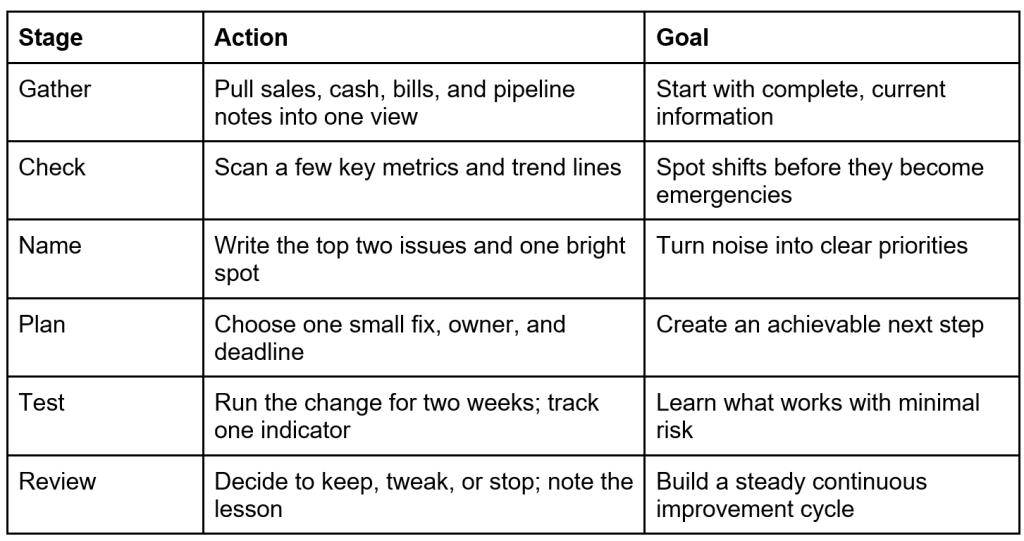
Each stage feeds the next: you gather facts, interpret them, then act in a small, controlled way. Over time, this loop makes decisions feel less personal and more practical, like steering by familiar landmarks.
Rebuilding a Small Business: Common Questions Answered
Q: What financing options should I look at first when cash is tight?
A: Start with the least complicated wins: invoice follow-ups, payment plans, and a clear 13 week cash forecast. Then compare a small line of credit, a term loan, or an SBA backed loan with fees and payoff timing spelled out. It can help to know the SBA delivered $56 billion in FY24, so you are not alone in seeking structured support.
Q: How do I market without a big budget or fancy tools?
A: Pick one channel you can sustain and show up consistently for 30 days. For many owners, simply creating and maintaining social media profiles is a practical starting point that keeps you visible while you rebuild. Post one helpful tip, one behind the scenes moment, and one offer each week.
Q: What should I prioritize when everything feels urgent?
A: Protect cash and customer trust first, because those buy you time. Choose one bottleneck that blocks sales, like slow quotes or missed follow-ups, and fix that before adding new projects. If it does not move revenue, reduce it, pause it, or delegate it.
Q: How can I re-engage past customers without sounding desperate?
A: Reach out like a neighbor, not a billboard: share what is new, what is improved, and one simple way to come back. Offer a small “welcome back” bonus tied to a clear deadline, and make the next step easy, like replying to the text or booking in two clicks. Ask one sincere question about what they want now.
Q: When should I try new offers versus doubling down on what used to work?
A: If your best seller still gets inquiries, tighten delivery and pricing before reinventing it. If demand has shifted, test one new offer as a limited pilot with a clear success metric, like five paid orders in two weeks. Keep the experiment small enough that it cannot sink your month.
Choose One Small Step to Strengthen Your Business Daily
When sales dip, cash feels tight, and every decision carries weight, it’s easy to freeze or chase too many fixes at once. The steadier approach is the one built throughout these key takeaways for rebuilding: focus on clear priorities, stay close to customers, and keep making business strengthening steps that fit the season you’re in. Small business recovery motivation comes from motion, not perfection. Applied consistently, that sustained growth mindset turns today’s scramble into calmer systems, better choices, and real entrepreneurial resilience. Small steps, repeated, rebuild a business faster than big plans you never start.

