


What Changes When Leaders Reach the Top: A Different Look at Leadership Development
A few years ago, I had the chance to coach a senior VP at a large engineering and construction company. He was a man who had led the technical backbone of the business, supervising hundreds of engineers and ensuring all the calculations that everything else depended on were spot on. His promotion was well-deserved, based on that incredible work. After he stepped into his new role for 18 months, I noticed something was quietly off. He understood what the role now required of him—he could clearly name the change, describe it, and even defend it in meetings. But, for some reason, he couldn’t seem to fully embrace or activate it. His CEO, in a pattern I still see too often at the top of organisations, kept the observations to himself. So, he kept running his part of the business the way he always had—relying on knowledge, analysis, and certainty.
Eventually, we were able to support him in landing a technical board position at another company abroad, where his unique background was just what they needed. He departed on good terms, and the experience stayed with me long after he moved on, especially as I began to notice the same pattern emerging in the data.

What the data shows
Since 2021, a total of 5,218 professionals from 42 countries speaking 15 languages have taken the 3 Brains Dominance assessment, which explores three key biological intelligence centers: the Head Brain, the Heart Brain, and the Gut Brain. This assessment helps us understand how a person’s decision-making might typically unfold in everyday life. Within this dataset, there are 619 leaders, 254 in middle management, and 365 at senior levels. Comparing these two groups reveals some truly interesting insights.
McKinsey has been sharing insights with us for years, based on data from 189,000 leaders across 81 organisations. They’ve shown that four key behaviours account for 89% of the differences between strong and weaker leaders. These are solving problems effectively, operating with a results-focused mindset, seeking out different perspectives, and supporting others. Interestingly, two of these- being analytical and decisive- correspond to ‘Head and Gut’ in 3 Brains language, while the other two, relational skills, are linked to the Heart. This means that half of what makes a leader effective actually resides in the biology of empathy, presence, and trust.
If you have read any of the leadership literature of the last twenty years, that may sound familiar, because emotional intelligence has long been sold as the thing that separates the senior leader from the middle manager. Here is where our data gently disagrees.
Heart-Brain capability at the senior level is statistically indistinguishable from Heart-Brain capability at the middle-management level. The means differ by a tenth of a point; the distributions lie almost on top of one another; p = 0.88. Whatever Heart capability senior leaders have, they had it already on the way up. Two other things changed, and both are significant.
Head softened. The very high analytical profile (45 and above) fell from 26.8% of middle managers to 21.4% of senior leaders (p = 0.009). The hyper-analyst thins out as people climb.
Gut activated. The proportion carrying a very low Gut score fell from 42.1% to 35.3%, p = 0.014, and the share of Gut-dominant leaders rose from 12.2% to 15.9%. The clearest signal separating senior leaders from middle managers in this dataset is the disappearance of low Gut.
Trust as an operational capacity
This is where the data began to change how I think about developing leaders.
In this framework, Gut Brain is where trust lives. Trust in yourself, trust in the process, trust in other people, trust in incomplete information. So, what these numbers may be describing is a population in which the instinct-suppressed analytical performer becomes rarer towards the top, and trust becomes something a leader can actually operate with.
Paul Zak’s twenty years of oxytocin research would suggest that trust is a biochemical event with measurable consequences: higher engagement, higher productivity and higher life satisfaction where it is present; burnout where it is absent. When Gallup tell us that 23% of the global workforce is engaged, and when change programmes land somewhere between 26% and 41% depending on which consultancy you ask, I dare to suggest we may be looking at the predictable output of leaders whose Heart Brain is present and whose Gut Brain has been quietly asked to stay silent.
The higher the stakes, the less complete the information, and the faster the decision has to be made. That is the leadership condition, and the question sitting underneath it is which biological system you can trust once the data runs out.
Three important implications
For those of us who design executive development, three implications may be worth sitting with.
Selection from middle management tends to reward the strongest analytical performer, who then meets a structural ceiling higher up, because the profile rewarded and the profile the top asks for are two different profiles.
Programmes that treat emotional intelligence as the senior leadership differentiator may be aiming at a variable that has already arrived. Heart Brain matters enormously, it is needed in equal measure at both levels, and it sits outside the change we can actually see between them.

Gut Brain activation, trust as an operational capacity, is trainable, biological and measurable, and in a world handing analytical work to artificial intelligence at speed, this is the human capability that stays.
The leaders at the top of this dataset are the ones in whom balance across the three Brains has quietly become the norm, and balance can be trained.
Author:
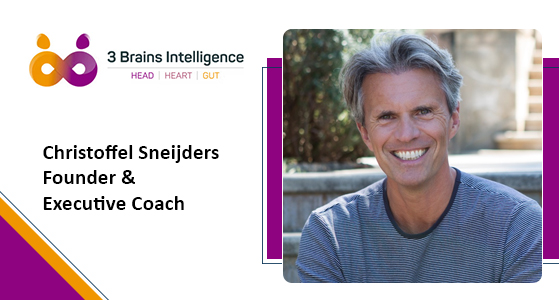
Christoffel Sneijders, MCC, is an executive coach, clinical psychotherapist, and the founder of 3 Brains Intelligence, where he has spent 33 years working with more than 13,000 clients across 40 countries. He is a Visiting Professor at IE Business School Madrid and Georgetown University Qatar, and the author of several books including Forget Mindset, Break Free to Thrive. His work draws on a dataset of more than 5,000 leadership assessments in 16 languages, exploring how the Head, Heart and Gut Brains shape the way people decide, lead and change.
Links for the author attribution


Company Name : 3 Brains Intelligence
Website : https://3brainsintelligence.com/
Management Team
Christoffel Sneijders | Founder & Coach

