
Where HR insight meets economic evidence
From HR Metrics to Measurable Value: How Openagora Is Rewiring the DNA of Talent Strategy
In boardrooms around the world, a familiar tension continues to surface. Organizations invest millions in performance management systems, engagement initiatives, leadership development programs, succession frameworks, and digital HR platforms. Dashboards multiply. Surveys are completed. Reports are presented.
And yet, when executive leaders ask a deceptively simple question — “How is this improving business results?” — the answers often feel incomplete.
This persistent disconnect between HR activity and measurable business impact is not a failure of effort. It is a failure of translation. And it is precisely this gap that gave birth to Openagora.
The Moment of Realization
For years, HR departments have been on a journey of digital transformation. Paper-based evaluations became cloud systems. Manual surveys became real-time engagement tools. Talent matrices moved from spreadsheets to enterprise platforms.
But digitalization, as Pablo Silva observed, does not automatically produce better decisions.
“Many organizations believe that once data is digitized, insight will follow,” Silva explains. “But having data is not the same as understanding economic consequences.”
The true challenge was never the absence of information. It was the absence of decision-oriented analytics — the kind that connects talent variables directly to financial performance, operational risk, and long-term value creation.
Openagora was built to confront this challenge head-on.

Redefining the Role of HR in the Executive Conversation
Historically, HR has struggled to shift its narrative from cost centre to value creator. Engagement scores improve — but what does that mean for profitability? Training completion rates rise — but does productivity follow? Performance ratings fluctuate — but what is the financial exposure tied to those shifts?
Openagora approaches HR through a fundamentally different lens: economic impact.
Rather than focusing solely on process automation or activity tracking, the company positions talent analytics as a strategic decision engine. Its framework connects performance, potential, engagement, leadership quality, and workforce dynamics to measurable business indicators such as turnover costs, productivity levels, operational risk, and succession vulnerability.
The goal is not to produce prettier dashboards. It is to produce defensible, executive-level insights.
These repositioning changes the conversation entirely. HR leaders are no longer presenting descriptive metrics. They are presenting quantified scenarios.
- What is the financial cost of losing high-potential employees?
- How much risk does a succession gap create in critical roles?
- Do higher performance ratings correlate with measurable productivity gains?
- Where are hidden inconsistencies in evaluation systems distorting resource allocation?
By answering these questions with analytical rigor, HR moves from reporting activity to demonstrating impact.
The Power — and Discipline — of Analytics and AI
Artificial intelligence has become a buzzword across industries, but Openagora treats it with deliberate restraint and methodological discipline.
Silva is clear: AI is not a replacement for human judgment. It is an augmentation tool.
Traditional HR decisions are often influenced by well-documented cognitive biases — halo effects, recency bias, central tendency, or overreliance on averages. These distortions are rarely intentional, but they accumulate over time, shaping compensation, promotions, and succession decisions in subtle yet powerful ways.
Openagora applies advanced analytics to detect patterns and inconsistencies invisible to manual review. Instead of treating performance scores as isolated data points, the platform analyses:
- Distribution patterns across teams and business units
- Stability of evaluations over time
- Alignment between ratings and objective outcomes
- Variance between managers
- Risk signals embedded in workforce segmentation
The emphasis is not on algorithmic opacity but on structured comparability and probabilistic reasoning.
By introducing statistical rigor into talent evaluation, organizations gain clarity: where ratings are inflated, where talent is underrecognized, where volatility suggests instability, and where potential risk may materialize into turnover or performance decline.
This analytical discipline transforms HR from intuition-driven to evidence-informed.
Measuring What Truly Matters
One of the most enduring frustrations for HR leaders is proving return on investment. Engagement programs can improve morale. Leadership training may enhance competencies. But executives demand clarity: What changed in financial terms?
Openagora directly links talent variables to economic proxies.
For example:
- Attrition of high performers can be translated into replacement costs, lost productivity, and knowledge drain.
- Succession gaps can be quantified in terms of operational disruption risk.
- Performance differentiation can be evaluated against output and profitability metrics.
- Engagement fluctuations can be modelled against retention probabilities.
The platform allows organizations to test hypotheses and simulate scenarios. What happens if performance differentiation increases? What if succession coverage improves? What is the cost of maintaining underperforming units without intervention?
By modelling these relationships, Openagora shifts HR from reactive reporting to proactive risk management.
In doing so, it reframes talent strategy as capital allocation strategy.
A Market Crowded with Tools — But Not with Answers
The HR technology landscape is saturated. Countless vendors promise automation, user-friendly dashboards, or plug-and-play analytics. Yet many share structural limitations: rigid data models, predefined reports, and heavy reliance on external consultants for meaningful customization.
Openagora’s differentiation lies in its architectural philosophy.
Instead of forcing organizations to adapt to fixed software logic, the platform adapts to the organization’s existing frameworks. Evaluation models, performance indicators, workforce segmentation, and reporting priorities can be configured without sacrificing methodological consistency.
Flexibility, however, does not mean lack of rigor. Openagora balances adaptability with statistical discipline, ensuring that customized models remain analytically sound.
Equally important is its service model. Rather than acting as a distant technology vendor, Openagora partners closely with clients through dedicated account management and advisory support. Analytics are not delivered as static outputs; they are translated into actionable, context-aware recommendations.
This combination — flexible architecture plus strategic partnership — positions the company differently in a crowded market.
The Digital Transformation Paradox
Across industries, HR departments have made undeniable progress in digitization. Automation has reduced administrative burden. Data availability has increased exponentially.
Yet a paradox persists: more data does not automatically mean better decisions.
Many organizations still rely on static reports, simple averages, or generic benchmarks that fail to capture complexity. Metrics are presented descriptively rather than analytically. Activity is mistaken for impact.
Silva identifies the core gap not as technological, but conceptual.
“The biggest challenge is analytical maturity,” he notes. “HR needs tools that support causal thinking, risk analysis, and trade-off evaluation — not just reporting.”
In other words, the future of HR is not about collecting more data. It is about asking better questions of the data.
Designed for Complexity
Organizations today are rarely homogeneous. Large enterprises operate across geographies, job families, hierarchical layers, and cultural contexts. A single average performance score tells little about what is truly happening beneath the surface.
Openagora is engineered to handle this complexity.
Whether deployed in mining operations, manufacturing environments, service organizations, or corporate headquarters, the platform allows granular segmentation and comparative analysis. Workforce segments can be examined independently and in relation to each other.
This is particularly critical in large organizations, where one-size-fits-all analytics can distort reality. By enabling detailed comparisons — across business units, leadership layers, or demographic segments — Openagora supports more precise and equitable talent decisions.
Complexity, rather than being simplified away, becomes analysable.
Leadership Philosophy: Clarity Over Hype
At the centre of Openagora’s evolution is a leadership philosophy grounded in intellectual honesty.
Silva resists the temptation to position analytics as magical or disruptive in a sensational sense. Instead, he emphasizes clarity, transparency, and long-term partnership.
Technology, in his view, should illuminate decisions — not obscure them behind opaque metrics.
This philosophy shapes both product development and client relationships. Listening deeply to organizational challenges, questioning assumptions, and co-creating solutions are central to the company’s operating model.
Trust is built incrementally — through consistent delivery of insights that improve decision quality over time.
Looking Forward: The Competitive Advantage of Evidence
The coming decade promises heightened uncertainty. Technological acceleration, evolving workforce expectations, demographic shifts, and talent scarcity will intensify pressure on organizations to make smarter people decisions.
In this environment, intuition alone will not suffice.
Organizations that can quantify the economic impact of talent strategies will gain a structural advantage. They will allocate development resources more efficiently. They will mitigate succession risk earlier. They will identify performance distortions faster. They will treat workforce planning as strategic forecasting rather than administrative planning.
Openagora positions itself at the centre of this transformation.
By connecting HR data directly to business impact, it enables leaders to move beyond surface metrics and into evidence-based strategy. The result is not merely improved reporting — it is improved decision-making.
And in the end, that is where competitive advantage truly resides.
From HR data to measurable business value, Openagora is not just redefining talent analytics. It is redefining how organizations think about people, performance, and profit — transforming HR from a function of activity into a function of impact.
“Where workforce intelligence meets measurable business impact”
“Turning people analytics into executive-level decisions that drive growth”
Company Name : Openagora
Website : https://www.openagora.com/
Management Team
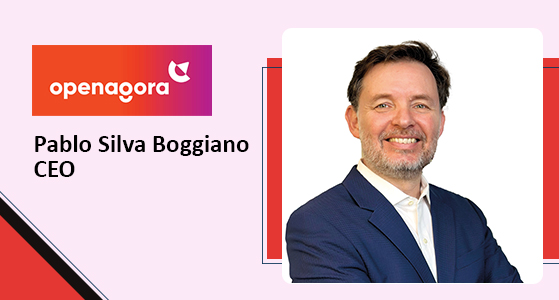
Pablo Silva Boggiano |CEO