


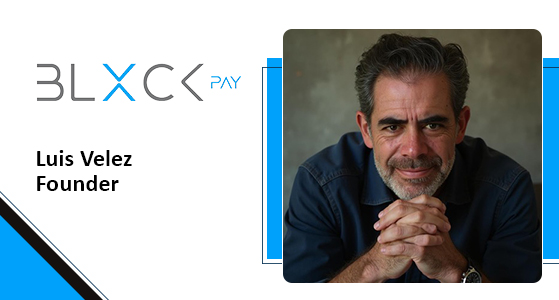
Building Financial Infrastructure for the Workforce the System Forgot
Infrastructure for the Invisible Workforce: How Luis Vélez Is Rewiring Financial Access with BlxckPay
In an industry often defined by speed, scale, and valuation metrics, Luis Vélez measures success differently. For him, the starting point isn’t technology or margins—it’s people. More specifically, it’s the millions of workers who form the backbone of critical industries yet remain overlooked by the financial systems meant to serve them. As the founder of BlxckPay, Vélez is building something far more fundamental than a fintech platform. He is constructing financial infrastructure for a workforce that has long operated in the shadows of modern banking.
Ask Vélez what BlxckPay does, and he won’t begin with payment rails or APIs. Instead, he describes a broken system one that simultaneously burdens employers with complexity while leaving workers underserved, underbanked, and often exploited by inefficiencies. At the intersection of these two realities lies BlxckPay, designed to remove friction and create a system where both sides walk away better off.
At its core, BlxckPay addresses a structural imbalance in the U.S. labour ecosystem, particularly within H-2A and H-2B visa programs. These programs bring hundreds of thousands of workers into agriculture, hospitality, and seasonal industries sectors that quite literally cannot function without them. Yet despite their essential role, these workers often face significant barriers when it comes to accessing and managing their earnings. From high remittance fees to a lack of formal banking options, the system has historically treated them as an afterthought.

Employers, meanwhile, face a different but equally pressing challenge. Managing a seasonal, international workforce comes with layers of regulatory and compliance obligations. Payroll isn’t just about paying wages—it’s about ensuring documentation, meeting federal standards, and avoiding costly errors that could jeopardize entire operations. Traditional payroll systems were never designed for this level of complexity, leaving employers to navigate a fragmented and inefficient process.
BlxckPay exists to solve both sides of this equation simultaneously. “When both the employer and the worker leave the table better off, you’ve built something real,” Vélez explains. “That’s the only version of this that matters.”
This philosophy didn’t emerge overnight. Vélez’s journey into financial inclusion began in Mexico City, where he grew up witnessing firsthand how systemic exclusion operates not as an abstract concept, but as a daily reality. He saw individuals who worked hard, contributed to their communities, and had legitimate financial needs, yet remained invisible to traditional banking institutions.
That early exposure shaped the trajectory of his career. In 2013, Vélez co-founded what would become Mexico’s largest prepaid card company, focusing initially on government social programs. At the time, millions of citizens were receiving welfare, pension, and subsidy payments, often in regions with little to no banking infrastructure. The challenge wasn’t demand it was access.
Rather than building from a distance, Vélez and his team went directly into these communities. They established physical distribution networks, trained local agents, and designed products tailored to users who might not have smartphones or even basic financial literacy. Trust wasn’t assumed it was earned through presence, consistency, and relevance.
The results were transformative. With over 26,000 points of sale and more than three million active cardholders, the company became the largest prepaid card infrastructure in Mexico. More importantly, it proved a critical insight that would later define BlxckPay: underserved populations are not difficult markets they are ignored markets.
But Vélez didn’t stop there. Instead, he followed the worker.
As he observed migration patterns, a clear continuity emerged. Many of the same individuals who lacked financial access in Mexico were traveling to the United States under legal work programs, only to encounter a new set of barriers. Despite operating within a formal labour framework, these workers remained excluded from mainstream financial services. They arrived without U.S. banking histories, often worked in rural or isolated locations, and relied on costly, inefficient channels to send money home.
At the same time, their employers were grappling with increasingly complex compliance requirements tied to these programs. Payroll errors weren’t minor inconveniences they were regulatory risks with significant consequences.
To Vélez, the parallels were unmistakable. “I saw exactly what I saw in Mexico in 2013,” he recalls. “A massive, unserved need on both sides of the same equation.”
BlxckPay is the direct response to that realization.
Operating as a licensed Super Program Manager on Visa rails, the platform streamlines payroll and financial access for both employers and workers. For businesses, it removes the administrative burden of managing compliant payroll systems for H-2A and H-2B employees. Payments are processed in a structured, documented, and legally compliant manner, reducing risk while improving operational efficiency.
For workers, the experience is designed with equal intentionality. BlxckPay doesn’t rely solely on digital onboarding a critical distinction for a population that may have limited access to technology. Instead, the company conducts in-person financial onboarding in Mexico before workers depart, and again upon arrival in the United States. This dual-touch approach ensures that users not only receive the tools they need but also understand how to use them.
Through integration with Visa Direct and a cross-border network of remittance partners, workers can send money home quickly and affordably—often the same day they earn it. What was once a fragmented and costly process becoming seamless and accessible.
The impact of this model extends beyond convenience. It reshapes the economic reality for both sides of the workforce equation. Workers retain more of their earnings, gaining greater financial stability and control. Employers benefit from reduced administrative strain and increased confidence in their compliance processes.
For Vélez, however, the ultimate measure of success is far more human.
Winning, he says, looks like a worker finishing a long shift and being able to send money to their family that same night without losing a significant portion of it to unnecessary fees. It looks like an employer running a complex labor program with the assurance that payroll is handled correctly, every time. And perhaps most importantly, it looks like a financial system that finally acknowledges the value of a workforce it has long overlooked.
BlxckPay is not just a product of technological innovation it is the result of lived experience, deep observation, and a commitment to solving problems at their root. Vélez’s approach challenges a common narrative in fintech: that disruption comes from building faster or more advanced systems. In his view, true innovation comes from building systems that actually serve the people who need them most.
There is also a broader implication to his work. As global labor markets become increasingly interconnected, the need for cross-border financial infrastructure will only grow. Seasonal and migrant workforces are not anomalies—they are essential components of modern economies. Yet the systems supporting them remain fragmented and outdated.
BlxckPay represents a shift toward a more inclusive model one that recognizes these workers not as edge cases, but as integral participants in the financial ecosystem. By addressing both employer and worker needs in a single, cohesive platform, Vélez is demonstrating that inclusion and efficiency are not mutually exclusive they are mutually reinforcing.
Looking ahead, the scale of the opportunity is immense. The industries served by H-2A and H-2B programs continue to expand, and with them, the demand for reliable, compliant, and accessible financial solutions. BlxckPay is positioned not just to meet that demand, but to redefine the standard.
For Vélez, the mission remains clear. Technology is a means, not an end. The real goal is to build infrastructure that works quietly, reliably, and equitably for the people who depend on it.
In a world increasingly driven by digital transformation, it is easy to overlook the human systems that underpin economic progress. Luis Vélez hasn’t overlooked them. He has built his career around them.
And with BlxckPay, he is ensuring that the workers who sustain entire industries are no longer invisible to the financial systems that shape their lives.
“BlxckPay is redefining payroll, access, and dignity for the workers powering America’s essential industries”
“Luis Vélez is bridging borders and banking gaps—creating a system where employers and workers finally win together”