
Leadership Doesn’t Fail. Structure Does.
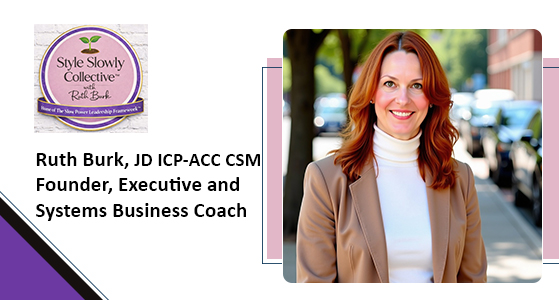
In conversation with Ruth Burk, Founder, Style Slowly Collective, LLC
You’ve built your work around the idea that leadership often breaks down structurally, not personally. When did you start seeing that at a leadership or executive level?
I began seeing this clearly when I was working on complex initiatives across law and technology. I was surrounded by highly capable leaders who were still feeling stretched, inconsistent, and overextended.
What stood out was that the issue was not capability or effort. It was that the systems around them were not designed for the conditions they were operating in.
Most leadership models assume linear careers, clear authority, and decision-making without constant scrutiny. That is not the reality, especially for women in visible leadership roles. As responsibility increased, so did relational and emotional expectations, while structural support did not keep pace.
That is when I realized leadership strain is rarely personal. It is structural.
This is the work I do with founders and executives as their roles expand and the systems around them struggle to keep pace.

The idea of “Slow Power” runs against the usual push for speed. How has that influenced the way you make decisions as a founder?
Slow Power has fundamentally changed how I make decisions. Instead of reacting to urgency, I focus on decision architecture.
That means defining clear criteria, understanding trade-offs, and separating actual risk from perceived pressure.
Speed often creates the illusion of progress, but without structure, decisions get reopened, conversations get revisited, and unnecessary tension builds.
I no longer optimize for speed. I optimize for decisions that hold.
This has allowed me to operate with more clarity and less rework, while maintaining consistency even as complexity increases.

When a leader feels stretched or inconsistent, what do you typically see breaking down in how they operate or lead their organisation?
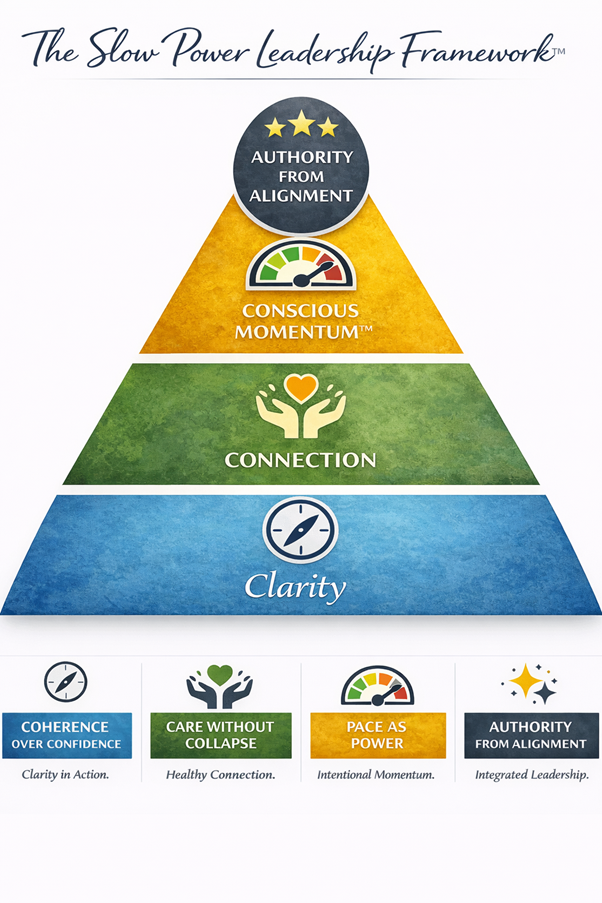
I consistently see breakdowns across three areas: clarity, connection, and momentum.
Clarity breaks down when decision criteria are not defined. Leaders begin second-guessing themselves, over-explaining, or compensating for anticipated reactions.
Connection breaks down when leaders absorb relational tension that should be held by the system. They end up translating, smoothing, and carrying responsibility that is not structurally theirs.
Momentum breaks down when urgency starts driving the system. Priorities shift too frequently, delegation weakens, and execution becomes dependent on the leader’s personal follow-up.
What appears as inconsistency is usually the result of these structural gaps
Many founders rely heavily on their own energy to drive the business. At what point does that start to limit scale?
It begins to limit scale once the business reaches a level of complexity where everything still runs through the founder. That includes decisions, follow-up, emotional regulation, and alignment across the team.
At that point, growth is no longer constrained by opportunity. It is constrained by how much the founder can carry.
If authority is still effort-based rather than structured, the founder becomes the bottleneck.
Sustainable scale requires shifting from personal energy to systems that hold decisions, ownership, and momentum independently.
Your framework centres on clarity, connection, and momentum. Which of these tends to impact leadership decisions the most when things are under pressure?
Clarity has the most immediate impact under pressure.
When decision criteria are not anchored, leaders begin compensating for scrutiny. They adjust tone, reopen decisions, and prioritize perceived reactions over strategic outcomes.
Clarity stabilizes judgment. It allows leaders to define trade-offs in advance and move forward without constantly renegotiating their decisions.
That said, all three pillars must align. Without connection, decisions are not held relationally. Without momentum, they are not sustained operationally.
You’ve worked across different industries. How has that shaped your approach to leading through complexity and change?
Working across law, technology, and entrepreneurship exposed me to different forms of complexity, but the underlying pattern was consistent.
High-performing leaders were adapting themselves to unstable systems instead of stabilizing the system itself.
This shaped my approach significantly. Rather than focusing on individual performance, I focus on structural alignment.
Complexity becomes manageable when decision-making, relationships, and pace are intentionally designed rather than reactively managed.
That is what allows leaders to operate steadily, even as conditions change.
As more businesses move toward purpose-driven models, what do you think leadership at the top needs to get right to sustain both growth and direction?
Purpose alone is not enough. Without structure, it creates burnout rather than sustainable growth.
Leaders need to ensure that their decisions, relationships, and execution are supported by systems that hold under pressure.
That includes clear decision criteria, defined ownership, and disciplined pace.
Purpose needs to be operationalized. It must be translated into how decisions are made, how accountability is structured, and how momentum is sustained.
When that alignment is in place, growth and direction reinforce each other rather than compete.

Company Name :
Style Slowly Collective
Website : https://www.styleslowly.com
Management Team
Ruth Burk | JD ICP-ACC CSM
Founder & Business Coach